

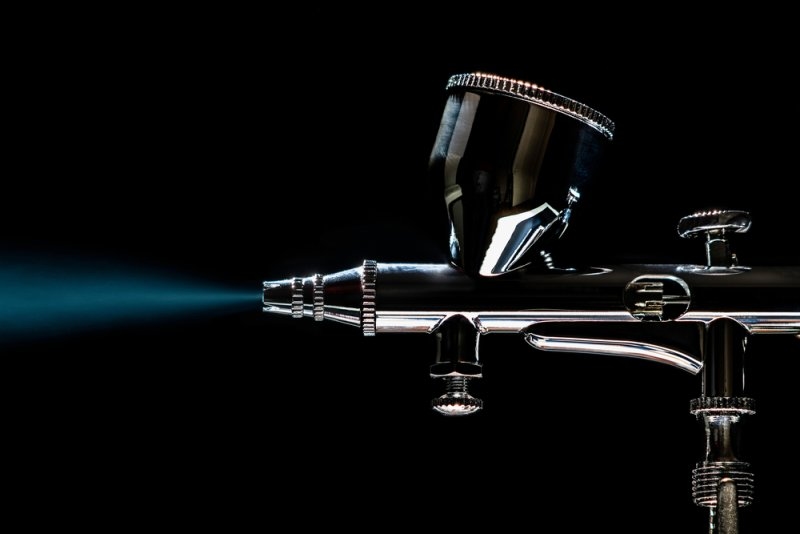
There have been numerous innovations in painting tools, with different techniques being used in art, automobile, furniture, and industrial painting. While both the airbrush and spray gun are tools that utilize compressed air to paint, their uses vary widely.
Knowledge of the difference between the two tools will be useful in the choice of the right equipment.
In the comparison of airbrush vs. spray gun, the most prominent thing to take into consideration is the difference in the scale of application and its precision.
An airbrush is a small instrument that allows for more accurate spraying, while a spray gun is a relatively large instrument intended for quick coating of wider surfaces.
Usually, airbrushes use smaller nozzles and function with a smaller amount of paint and air pressure. This equipment is often used in creating works of art, painting models, applying makeup, customizing, and finishing touches.
As for spray guns, they are used where speed and large area coverage matter. Such an instrument is usually applied for automobile painting, furniture coating, construction, and industrial purposes.
The selection of the appropriate one depends on the intricacy of the task.
Also check: Air Compressor for Airbrush That Makes Every Stroke Count
The correct paint applicator will be determined by the nature of the project. The airbrush vs. spray gun for painting becomes evident when examining how they are used and their results.
The use of airbrushes allows for greater precision of paint application. They enable one to achieve a gradient of color, fine lines, shadows, and patterns. They are more appropriate when one is doing artistic work.
On the other hand, spray guns are good for large painting projects. They will allow you to apply the paint to larger areas within a shorter period of time.
In the case of a small project, an airbrush can be more efficient than a spray gun. For instance, an artist working on a miniature sculpture will prefer an airbrush for his work.
There is an obvious difference between airbrush and spray gun uses since they are built to handle different types of projects.
The most common uses of airbrushes include:
Airbrushes are ideal for use where creativity and precision are needed due to the precision they provide.
Some common applications of spray guns include:
Spray guns are ideal where one needs fast work and uniform coverage of large surfaces.
The main differences between these tools come down to accuracy. Airbrush vs. spray gun accuracy demonstrates the reason why people choose various tools depending on their purposes.
The accuracy of airbrushing is exceptionally high since users can manipulate air and paint flow as well as use small spray patterns. Therefore, this tool is useful for making various delicate details and applying various color blends.
In contrast, spray guns do not give users the ability to make delicate manipulations and create fine lines. These tools are created to be used efficiently.
When accuracy and small manipulations are important factors for any project, an airbrush should be used. When consistency is the main point, a spray gun will give better results.
The coverage is yet another crucial aspect to consider when comparing these tools. The main point of difference when it comes to the airbrush vs. spray gun coverage is the size of the spray pattern and amount of paint released.
Airbrushes have smaller spray patterns and can be used only for detailed sections because they allow precise work and slow coverage of the surface. However, these tools suit those who prefer to apply paint with precision.
On the contrary, spray guns allow quick coverage of large surfaces due to their large spray patterns and greater paint release.
This tool allows completing bigger projects. Thus, users may use spray guns on vehicles, furniture, and industrial surfaces.
Must Read: Mastering Airbrush Masking Techniques and Depth in Artwork
Choice of tools may also be determined by the type of paint used. Paint airbrush or spray gun paint comparisons involve the paint consistency, viscosity, and application needs.
Thin paint should be applied using an airbrush since the paint nozzle of the tool can easily get clogged when thick paint is used. There are special types of paint for the airbrush machine that will flow easily through the tool.
On the other hand, spray guns can use thicker coats of paint since they have larger nozzles and stronger airflow. Paint guns are used mainly for automotive paint, primer, lacquer, and protective coats of paint.
Cost is also a factor for both beginners and professional artists. The comparison between airbrush and spray gun costs is based on the quality of equipment, accessories, and intended use.
Airbrush sets are normally less expensive for working on smaller tasks. A minimum set might consist of an airbrush, compressor, and cleaning materials. Nevertheless, professional sets with unique capabilities could be more expensive.
A set of spray guns needs more powerful compressors, equipment, safety measures, and a ventilation system. Although the starting price is higher, these sets are suitable for professional use.
Choosing the most cost-effective option depends on the frequency of using the tool and the nature of work to be performed.
For beginners, choosing a proper tool will depend on the kind of work they wish to do. The choice between an airbrush vs. a spray gun for beginners reveals that different tools have various learning needs.
An airbrush is relatively easier for beginners who wish to develop artistic skills since it gives them more control and works on small projects. Beginners will need to be patient when learning how to mix paints, handle airflow, and clean airbrushes.
Spray guns might take longer to prepare due to the large equipment, safety issues, and handling of paints, but they are suitable for beginners doing automotive, furniture, or home improvement painting work.
Before spending money on equipment, beginners should determine their aims for the painting project to know whether to go for an airbrush or a spray gun.
Choosing either the airbrush or spray gun will depend on knowledge of the intended purpose of the job or project at hand. While airbrushes are best for intricate jobs, creative projects, and precision painting, spray guns work well where time, economy, and scale of operations are important.
Taking into consideration the nature of the paint, the size of the surface to be painted, costs, and expertise of the user, one can select the appropriate device for the intended painting application.
An airbrush is able to be used for some professional works that may need some precision and detail, but it will not be able to fully replace a spray gun for large work.
Both tools are able to give a smooth paint finish when they are used properly. An airbrush is more suitable for detailing and blending, while the spray gun is widely used for obtaining a uniform finish.
Airbrushing relies on practice, technique, and the difficulty level of the job. It is quite easy for a beginner to learn basic techniques, but for achieving advanced techniques, consistent practice is needed.
Yes, both tools require regular cleaning to maintain performance. Airbrushes need careful cleaning because of their smaller components, while spray guns require proper maintenance to prevent paint buildup and ensure consistent spraying.
Spray guns are generally preferred for automotive painting because they provide wider coverage and handle automotive coatings effectively. Airbrushes are often used alongside spray guns for adding custom designs, details, and artistic effects.
This content was created by AI